

Contact · Newsletter · DEUTSCH
Although all individual components underwent unit testing, their interoperability was verified through integration and functional tests, and a comprehensive system test was successfully conducted as a final step, some assemblies still fail immediately after the new software is delivered to the customer.
And, in fact, the causes are known:
After all, the tests mentioned above were conducted in the development environment and in specialized testing laboratories.
However, environmental conditions – and especially potential sources of interference in a real-world application environment – often hold numerous surprises, particularly when wireless functions and battery operation are used. Added to this is the “creativity” of end users, which can result in unpredictable interaction sequences.
A typical question in this context is therefore:
How do we determine the causes of each individual failure, and what changes are necessary? The WRD Toolbox offers various tools to answer precisely these questions.

Fig. 1: Wireless remote debugging with the WRD/Probe
The WRD/Probe features a rechargeable battery with a runtime of up to 12 months without recharging, depending on the specific usage profile and the connected target device. This makes even long-term field tests possible without any problems.
It can be used anywhere with an LTE-M cellular connection and connects fully automatically to your development environment via a rendezvous service on the Internet (WRD Services).
The WRD/Probe uses common standards and provides a GDB interface that integrates seamlessly into your familiar IDE, such as VSCode or Eclipse. This effectively creates a “virtual” debug cable.
Starting build processes, setting breakpoints, checking variables, etc. – everything remains the same, so you can stick to your usual workflow.

Fig. 2: Wireless remote testing and monitoring with the WRD/Box
WRD/Boxes consist of a rugged industrial enclosure in which the components for a specific task are mounted on a 35 mm DIN rail. Remote access is typically established via a 4G modem that includes a global SIM card for worldwide use.
Depending on the configuration, the following applications, among others, are possible:
Remote Assisted Development:
Team-based development directly in the target environment, e.g., an AI soft sensor for a machine. The WRD/Box is equipped with the appropriate hardware and software so that developers can access it from various locations.
IoT Data Aggregation:
Collect, combine, and summarize raw data from networked sources (e.g., machines, systems, sensors) to create a meaningful overall picture.
Remote Diagnostics:
Remote diagnostics and comprehensive end-to-end (E2E) testing to examine the behavior of assemblies and subsystems on-site in detail and identify any existing issues.
Remote Access:
VPN-, SSH-, or HTTPS-based remote access to the WRD/Box itself or to functional units connected to it on-site.
Remote Debugging:
Execute debugging tasks remotely, such as single-step code execution, setting breakpoints, trace data collection, etc.
Remote Software Updates (OTA):
Update features, improvements, and bug fixes by replacing the firmware/software in on-site assemblies and subsystems (Device Flash Updates, DFU).

Our Chief Technician Marc Kerski would be happy to show you in a personal live online demo what possibilities and advantages the WRD/Box offers and how easy IoT data prototyping is with it.
Simply send us your preferred date and time.
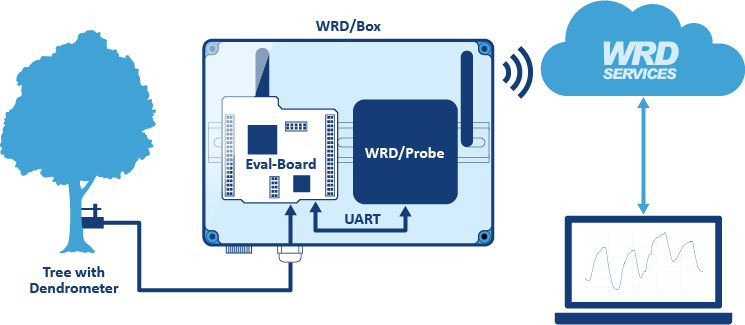
Fig. 2: Diagram of the field test setup with WRD/Box and WRD/Probe plus evaluation board
The customer provided us with the following requirements:
Due to the tight budget, the only viable option was an electronic system featuring a highly integrated MCU that provided both an ADC for the dendrometer measurement data and a sub-GHz wireless interface, plus sufficient flash memory for OTA updates and an A/B boot concept.
The ADC also had to enable highly accurate measurements in the micrometer range (μm) and ensure that the wireless interface could maintain a range of several hundred meters even in a rain-soaked forest.
Based on these requirements, we opted for the STM32WL55 MCU. We selected the STM32WL Nucleo-64 as the evaluation board for this MCU.
And then we got right to work on the actual development of the following three core functions.
The Dendrometer Interface:
Because the measurements are in the micrometer range, at least a 16-bit ADC was required.
However, since the STM32WL55 MCU only has a 12-bit ADC, we had to develop a 4-bit oversampling method.
Temperature compensation of the measured values might also have been necessary; this was to be determined through field testing.
The Radio Interface:
After defining the technical details (frequency band, channel bandwidth, modulation, etc.), we implemented the radio connection using the evaluation board.
The field test was needed to determine whether the requirements for range and signal quality were met.
Power Management for Battery Operation:
First, we defined the individual MCU operating states and determined the required current consumption in order to select the appropriate battery size.
The field test was needed to verify the state-dependent operating currents in the real-world application environment.
The entire development of this wireless IoT outdoor sensor therefore required many different tests that could only be conducted and reliably verified in the real-world application environment (in this case, a forest):
For the subsequent field test, we equipped several weatherproof WRD/Boxes – each with an evaluation board and WRD/Probe – had the customer mount them on trees in the forest, and intensively tested all functions using real dendrometer data over several weeks under a wide variety of conditions.
During the test phase, we then replaced the evaluation board with the first prototypes of the final IoT sensor.
The WRD Toolbox consists of the WRD/Probe (including the WRD Client), the WRD/Box, and the WRD Services. These tools are designed for debugging, end-to-end testing, and monitoring of (wireless) IoT applications.
The WRD/Probe is a self-contained wireless remote debugger with a built-in battery and LTE connectivity.
The browser-based WRD Client runs on the development computer and offers the following functions, among others: establishing a secure connection to the WRD/Probe, providing telemetry data from the WRD/Probe, and configuring the interface (GDB server, UART bridge) between the WRD/Probe and the connected target device.
The WRD/Box consists of a weatherproof installation enclosure with a 35 mm DIN rail, is custom-configured, and is used for remote testing and monitoring.
The cloud-based WRD Services act as a rendezvous server between the development computer and the WRD/Probe or the WRD/Box and enable, among other things, OTA updates.
The WRD/Probe is a self-contained wireless remote debugger designed specifically for field testing of (wireless) IoT devices and embedded systems under real-world conditions, allowing numerous debugging tasks to be performed directly in the application environment through field or end-to-end (E2E) testing.
The WRD/Box is configured as needed depending on the task at hand. It enables a wide variety of remote applications, such as remote-assisted development, IoT data aggregation, remote diagnostics, remote access, remote debugging, remote software updates (OTA), OT/IT connectivity, IoT connectivity, or embedded AI/machine learning.
For specific tasks, the WRD/Box can also be equipped with the WRD/Probe, as demonstrated in the practical example described above involving the development of an IoT wireless outdoor sensor.
Depending on the configuration, the tools in the WRD Toolbox can be used for a wide variety of remote applications, including remote-assisted development, IoT data aggregation, remote diagnostics, remote access, remote debugging, remote software updates (OTA), OT/IT connectivity, IoT connectivity, and embedded AI/machine learning.
SSV SOFTWARE SYSTEMS
Dünenweg 5
30419 Hannover
Phone: +49(0)511 · 40 000-0
Fax: +49(0)511 · 40 000-40
© 2026 SSV SOFTWARE SYSTEMS GmbH // All rights reserved.
ISO 9001:2015

